Introduction
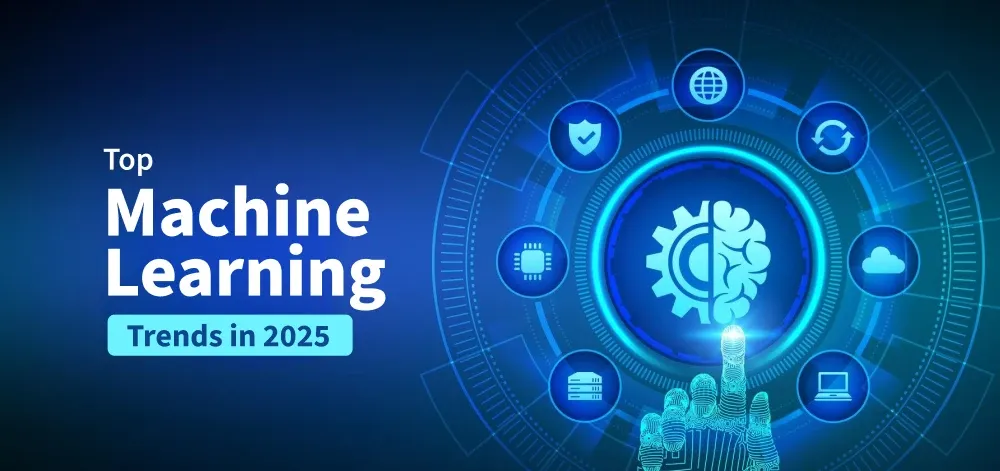
Machine learning has transcended the hype cycle and firmly established itself as a critical business capability. As we navigate through 2025, the ML landscape is maturing rapidly, with technologies once considered cutting-edge now becoming standard practice. For businesses looking to maintain competitive advantage, understanding these trends isn’t optional—it’s essential. This comprehensive guide explores the key machine learning trends reshaping the business landscape and provides actionable insights for organizations ready to leverage them.
The Democratization of AI: Foundation Models Take Center Stage
The most transformative trend of 2025 is the widespread adoption of foundation models. These large-scale, pre-trained models—capable of handling multiple tasks across domains—are revolutionizing how businesses approach ML deployment.
Gone are the days when organizations needed massive datasets and months of training to build effective ML models. Foundation models like GPT-4, Claude, Llama, and domain-specific alternatives have created a new paradigm: businesses can now fine-tune powerful pre-trained models with relatively small datasets, dramatically reducing time-to-value and resource requirements.
Key Business Implications:
Reduced Barriers to Entry: Small and medium enterprises can now access state-of-the-art AI capabilities that were previously exclusive to tech giants. This democratization is leveling the competitive playing field across industries.
Faster Innovation Cycles: With foundation models as a starting point, businesses can iterate and deploy new AI applications in weeks rather than months, enabling rapid experimentation and learning.
Cost Efficiency: Instead of training models from scratch, organizations can leverage transfer learning and fine-tuning, significantly reducing computational costs and carbon footprints.
Multimodal Capabilities: Modern foundation models handle text, images, audio, and video seamlessly, enabling businesses to build richer, more intuitive user experiences.
The Rise of Small Language Models (SLMs)
While large language models dominate headlines, 2025 has seen explosive growth in Small Language Models—compact yet powerful models optimized for specific use cases. These models, typically ranging from 1-10 billion parameters, offer compelling advantages for businesses:
Edge Deployment: SLMs can run on local devices, enabling privacy-preserving applications that process sensitive data without cloud transmission. This is particularly valuable in healthcare, finance, and regulated industries.
Lower Latency: On-device inference eliminates network round-trips, providing near-instantaneous responses critical for real-time applications like customer service chatbots and manufacturing quality control.
Cost Optimization: Smaller models require less computational power, translating to lower operational costs—especially important for high-volume applications.
Domain Specialization: Purpose-built SLMs trained on specific industry data often outperform general-purpose large models for specialized tasks while using a fraction of the resources.
Businesses are increasingly adopting a hybrid approach: using large foundation models for complex reasoning tasks while deploying specialized SLMs for routine operations, optimizing the cost-performance trade-off across their AI portfolio.
Generative AI Beyond Text: Visual and Audio Revolution
While text-based generative AI captured attention in 2023-2024, 2025 marks the maturation of generative models across all modalities:
Visual Content Generation: Businesses are leveraging advanced image and video generation models for:
- Marketing and advertising creative development with unprecedented speed
- Product visualization and virtual prototyping in manufacturing
- Personalized content creation at scale for e-commerce
- Architectural and design visualization for real estate and construction
Audio and Voice Synthesis: Realistic voice cloning and audio generation are transforming:
- Customer service with natural-sounding voice assistants
- Content localization with automated dubbing and translation
- Accessibility features for vision-impaired users
- Podcast and audiobook production workflows
3D and Spatial Content: Emerging 3D generative models are enabling:
- Rapid prototyping for industrial design
- Virtual and augmented reality content creation
- Gaming asset generation
- Digital twin development for smart manufacturing
MLOps Maturity: From Experimentation to Production at Scale
As ML adoption grows, organizations are discovering that the real challenge isn’t building models—it’s deploying and maintaining them reliably at scale. MLOps (Machine Learning Operations) has evolved from a buzzword to a critical discipline in 2025.
Key MLOps Trends:
Automated Model Monitoring: Advanced monitoring systems now detect model drift, data quality issues, and performance degradation in real-time, triggering automatic retraining pipelines when necessary.
Feature Stores: Centralized feature repositories enable teams to share, version, and serve features consistently across multiple models, reducing duplication and ensuring consistency.
Model Governance: With increasing regulatory scrutiny, businesses are implementing comprehensive governance frameworks tracking model lineage, ensuring explainability, and maintaining audit trails.
Continuous Training: Leading organizations are moving beyond static models to continuous learning systems that automatically incorporate new data and adapt to changing patterns.
A/B Testing Infrastructure: Sophisticated experimentation platforms enable safe model deployment with gradual rollouts, champion-challenger comparisons, and automated decision-making.
Edge AI and Federated Learning
Privacy concerns and latency requirements are driving AI to the edge. In 2025, businesses are increasingly deploying ML models on edge devices—from smartphones and IoT sensors to autonomous vehicles and industrial equipment.
Federated Learning has emerged as a game-changing approach, enabling organizations to train models across distributed devices without centralizing sensitive data. This technology is particularly transformative for:
Healthcare: Hospitals can collaboratively train diagnostic models without sharing patient data, improving accuracy while maintaining privacy.
Financial Services: Banks can build fraud detection models using collective intelligence without exposing customer transactions.
Retail: Multi-location retailers can optimize inventory and pricing using distributed learning across stores.
Manufacturing: Factories can share insights about equipment failures and quality issues without revealing proprietary processes.
Responsible AI and Ethical Considerations
As AI systems become more powerful and pervasive, responsible AI practices have moved from optional guidelines to business imperatives in 2025:
Bias Detection and Mitigation: Organizations are implementing systematic processes to identify and address bias in training data and model outputs, recognizing that biased AI can cause significant reputational and legal damage.
Explainability Requirements: Regulatory frameworks increasingly demand that businesses explain AI-driven decisions, particularly in high-stakes domains like lending, hiring, and healthcare. Explainable AI (XAI) tools are becoming standard components of ML pipelines.
Privacy-Preserving Techniques: Differential privacy, homomorphic encryption, and secure multi-party computation are transitioning from research concepts to practical tools for protecting individual privacy while enabling ML.
Sustainability Considerations: Organizations are measuring and optimizing the carbon footprint of their ML operations, with energy-efficient model architectures and training techniques becoming selection criteria.
AI Agents and Autonomous Systems
2025 has seen significant advancement in AI agents—systems capable of perceiving environments, making decisions, and taking actions to achieve goals with minimal human intervention:
Business Process Automation: Intelligent agents are automating complex workflows spanning multiple systems, from supply chain optimization to financial planning and analysis.
Customer Interaction: Advanced conversational agents handle increasingly sophisticated customer inquiries, seamlessly escalating to humans only when necessary.
Research and Discovery: AI agents are accelerating scientific discovery by autonomously designing experiments, analyzing results, and proposing hypotheses in fields from drug discovery to materials science.
Code Generation and Software Development: AI coding assistants have evolved into capable pair programmers that understand context, suggest architectures, write tests, and even debug complex issues.
Industry-Specific ML Applications
Machine learning is creating transformative value across industries:
Healthcare: Diagnostic AI achieving expert-level accuracy in radiology, pathology, and ophthalmology. Predictive models identifying patients at risk of deterioration. Drug discovery accelerated by AI-designed molecules.
Financial Services: Real-time fraud detection with sophisticated behavioral analysis. Algorithmic trading with advanced market prediction. Personalized financial advice powered by comprehensive customer understanding.
Retail and E-commerce: Hyper-personalized recommendations going beyond products to entire shopping experiences. Dynamic pricing optimization. Computer vision-powered checkout systems eliminating friction.
Manufacturing: Predictive maintenance reducing downtime. Quality inspection using computer vision achieving superhuman accuracy. Supply chain optimization with demand forecasting.
Agriculture: Precision farming with crop health monitoring via satellite and drone imagery. Yield prediction models informing planting decisions. Automated harvesting with robotic systems.
The Role of Synthetic Data
Real-world data limitations—whether due to scarcity, privacy constraints, or imbalanced distributions—have made synthetic data generation a critical capability in 2025:
Privacy-Preserving Training: Organizations generate synthetic datasets that preserve statistical properties while protecting individual privacy, enabling ML development without exposing sensitive information.
Rare Event Simulation: Synthetic data helps train models for uncommon but critical scenarios—from fraud detection to autonomous vehicle edge cases—where real examples are insufficient.
Bias Correction: Carefully generated synthetic data can balance datasets, helping mitigate historical biases and improve model fairness.
Cost Reduction: In domains where data collection is expensive (medical imaging, destructive testing), synthetic data supplements real examples economically.
Preparing Your Business for the ML Future
To capitalize on these trends, businesses should focus on several strategic imperatives:
Build Data Foundations: ML success requires quality data. Invest in data infrastructure, governance, and quality management before scaling ML initiatives.
Develop Internal Capabilities: While vendor solutions are valuable, internal ML expertise is essential for strategic differentiation. Invest in training existing staff and recruiting specialized talent.
Start with Business Problems: Technology-first approaches often fail. Begin with clear business objectives and identify where ML can create measurable value.
Embrace Experimentation: Not every ML initiative will succeed. Create organizational cultures that encourage rapid experimentation, learning from failures, and scaling successes.
Partner Strategically: The ML ecosystem is vast. Strategic partnerships with vendors, research institutions, and other organizations can accelerate capabilities and reduce risk.
Prioritize Responsible AI: Build ethical considerations into ML development from the start. Reactive approaches to bias, privacy, and explainability are costly and risky.
Invest in Infrastructure: MLOps platforms, compute resources, and data infrastructure are foundational investments that pay dividends across all ML initiatives.
Conclusion
Machine learning in 2025 represents a fundamental shift in how businesses operate, compete, and create value. The trends outlined here—from foundation models and edge AI to responsible AI practices and industry-specific applications—are not distant possibilities but current realities shaping competitive dynamics across sectors.
Success in this landscape requires more than adopting the latest technologies. It demands strategic thinking about where ML creates genuine business value, organizational commitment to building necessary capabilities, and ethical consideration of AI’s societal impacts. Businesses that thoughtfully navigate these trends, balancing innovation with responsibility, will find themselves well-positioned for the AI-driven future that’s already unfolding.
The question is no longer whether to invest in machine learning, but how to do so strategically, responsibly, and effectively. Organizations that answer this question well will thrive in 2025 and beyond.